10 Essential High-Income Career Skills You Can Learn Without a CS Degree
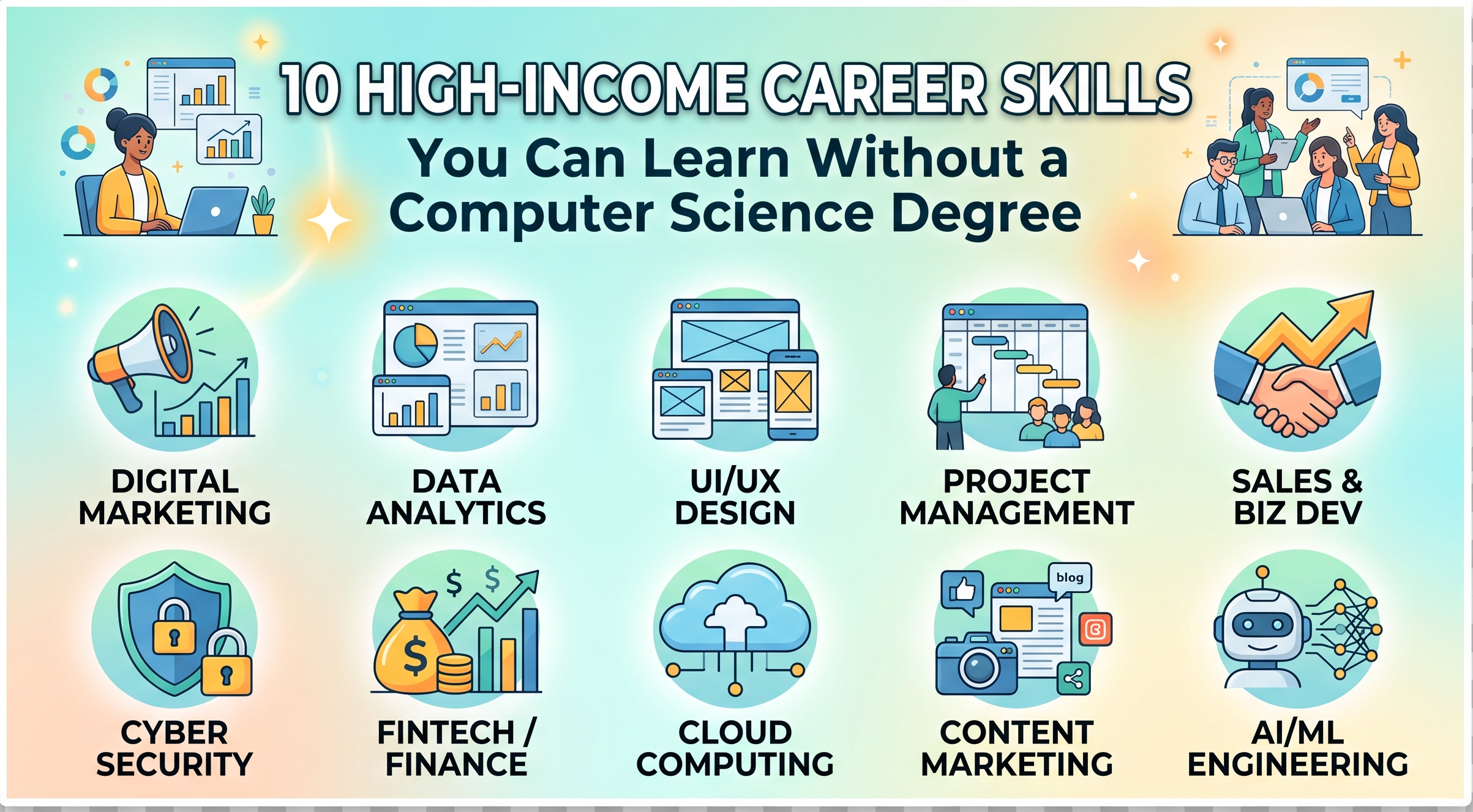
10 High-Income Career Skills You Can Learn Without a Computer Science Degree
However, discover practical, career skills without a computer science degree that keep you competitive—if you haven’t studied computer science.
Artificial Intelligence, automation, and digital transformation are changing the job market faster than ever. Nevertheless, many professionals believe career skills without a computer science degree are needed to build a successful technology career.
The reality is very different.
Today’s online learning ecosystem has made technical and business-focused skills more accessible than ever. Whether you’re a student, working professional, entrepreneur, or someone planning a career switch, you can begin learning valuable skills from home using structured courses, hands-on practice, and consistent effort.
What matters most isn’t having the perfect educational background. It’s having a clear learning roadmap, practical experience, and the willingness to keep improving.
What You Really Need to Get Started
You don’t need to become a software engineer overnight. Instead, focus on building strong foundations with:
- A structured learning roadmap
- Beginner-friendly online courses
- Practical projects to apply your knowledge
- A few dedicated hours every week
- Consistent practice and curiosity
Over time, these habits can help you develop skills that employers increasingly value across industries.
Let’s explore ten career skills that are worth learning in today’s digital economy.
1. Project Planning and Execution
Google Project Management Professional Certificate: https://imp.i384100.net/GjN7eV
Successful organizations rely on professionals who can transform ideas into completed projects.
Project planning isn’t just about creating schedules—it’s about coordinating people, managing risks, tracking progress, and ensuring business objectives are achieved.
By learning project management fundamentals, you’ll understand how to:
- Define project objectives
- Create project plans
- Manage stakeholders
- Allocate resources effectively
- Identify and mitigate risks
- Improve team collaboration
- Deliver projects on time
These capabilities are valuable in IT, healthcare, banking, manufacturing, government, marketing, and virtually every modern industry.
Who should learn it?
- Project Managers
- Business Analysts
- Team Leaders
- Entrepreneurs
- Fresh graduates
2. Prompt Engineering
Google Prompting Essentials: https://imp.i384100.net/rEnr63
Google Prompting Essentials: to communicate effectively with AI systems is emerging as a valuable professional skill.
Prompt engineering is the practice of writing clear, structured instructions that help AI tools generate more useful and accurate responses.
Learning prompt engineering can help you:
- Create better AI outputs
- Automate repetitive work
- Improve content creation
- Support research
- Generate business ideas
- Build reusable AI workflows
Rather than replacing expertise, prompt engineering helps professionals work more efficiently alongside AI.
3. AI Literacy
AI for Everyone: https://imp.i384100.net/mOdaa7
Artificial Intelligence is influencing industries ranging from finance and healthcare to education, retail, logistics, and manufacturing.
However, using AI effectively starts with understanding what it can—and cannot—do.
AI literacy involves learning:
- Basic AI concepts
- Machine Learning fundamentals
- Responsible AI usage
- AI limitations
- Ethical considerations
- Business applications of AI
Professionals with strong AI literacy are better equipped to evaluate AI-generated insights and make informed decisions.
4. Practical AI Applications
Google AI Professional Certificate: https://imp.i384100.net/rEnb5d
Knowing AI theory is valuable, but applying AI to everyday work delivers even greater impact.
Professionals are increasingly using AI to:
- Summarize documents
- Generate reports
- Conduct research
- Analyze information
- Brainstorm ideas
- Improve productivity
- Support decision-making
The key is learning how to integrate AI into existing workflows while maintaining human oversight and critical thinking.
5. Data Analytics
Google Data Analytics Professional Certificate: https://imp.i384100.net/L0PZKa
Data has become one of the most valuable business assets.
Organizations generate enormous amounts of information every day, but data only becomes useful when someone can analyze it and extract meaningful insights.
Learning data analytics enables you to:
- Collect and clean data
- Identify patterns
- Create dashboards
- Visualize trends
- Support strategic decisions
- Measure business performance
Data analytics is valuable across marketing, finance, HR, operations, healthcare, product management, and many other domains.
6. AI-Enhanced Productivity
AI isn’t only about advanced technologies—it’s also about working smarter.
Modern professionals use AI to streamline daily activities such as:
- Writing emails
- Organizing meeting notes
- Creating presentations
- Summarizing documents
- Scheduling work
- Generating ideas
- Managing repetitive tasks
By automating routine work, professionals can dedicate more time to problem-solving, collaboration, and innovation.
7. Cybersecurity Foundations
As organizations become increasingly digital, protecting systems and information has become everyone’s responsibility—not just the IT department’s.
Learning cybersecurity fundamentals helps you understand:
- Common cyber threats
- Safe online practices
- Network security basics
- Risk management
- Data protection
- Incident response
- Security awareness
Even non-technical professionals benefit from understanding how to recognize and reduce digital risks in the workplace.
8. Digital Marketing and E-commerce
Businesses today compete in a digital-first marketplace, making online marketing skills increasingly valuable.
Digital marketing combines creativity with data-driven decision-making to help organizations reach the right audience.
Core topics include:
- Search Engine Optimization (SEO)
- Social Media Marketing
- Content Marketing
- Email Marketing
- Online Advertising
- Customer Analytics
- E-commerce Strategy
These skills are useful for entrepreneurs, marketers, freelancers, consultants, and business owners looking to grow their online presence.
9. User Experience (UX) Design
A great product isn’t just functional—it should also be intuitive, accessible, and enjoyable to use.
UX Design focuses on understanding users and creating experiences that solve real problems.
Key areas include:
- User research
- Journey mapping
- Wireframing
- Prototyping
- Usability testing
- Accessibility
- Interaction design
Organizations increasingly value professionals who can bridge business objectives with customer needs.
10. Generative AI and Large Language Models
Generative AI has become one of the fastest-growing technology domains.
Understanding how Large Language Models (LLMs) work can help professionals make better use of AI-powered tools and evaluate where they are most appropriate.
Topics worth exploring include:
- Foundation models
- Prompt design
- Retrieval-Augmented Generation (RAG)
- AI assistants
- Business automation
- Responsible AI
- Enterprise AI adoption
You don’t need to build these systems from scratch to benefit from understanding how they work and where they can create value.
Why These Skills Matter More Than Certificates
While certifications can demonstrate learning, employers increasingly value the ability to apply knowledge in real-world situations.
Developing practical skills can help you:
- Solve business problems more effectively
- Make better decisions using data
- Collaborate confidently with AI tools
- Improve productivity
- Strengthen communication
- Manage projects successfully
- Understand digital risks
- Design user-focused solutions
- Adapt to changing technologies
The goal isn’t simply to collect certificates—it’s to build capabilities that create measurable value.
How to Start Your Learning Journey
If you’re feeling overwhelmed, don’t try to learn everything at once.
A practical approach is to:
Month 1
Focus on Project Management or AI Literacy.
Month 2
Learn Prompt Engineering and Practical AI Applications.
Month 3
Explore Data Analytics fundamentals.
Month 4
Build Digital Marketing or UX Design skills.
Month 5
Study Cybersecurity basics.
Month 6
Expand your understanding of Generative AI and Large Language Models.
Small, consistent progress often leads to meaningful long-term growth.
final Thoughts
Technology is evolving rapidly, but opportunities are expanding as well.
Now, the barriers to entering technology-related careers are lower than they were just a few years ago.
Moreover, diverse learners can cultivate career skills without a computer science degree through online resources and practical projects.
Whether your goal is career advancement, a transition into a new field, or simply staying relevant in an AI-driven workplace, investing in continuous learning is one of the best decisions you can make.
Start with one skill, practice consistently, apply what you learn to real-world scenarios, and keep building your expertise over time. The future belongs to professionals who embrace learning, adapt to change, and combine technical understanding with problem-solving and collaboration.